
Devotional
Luke 15:11-24 Devotional: The Father Who Runs
Luke 15:11-24 tells of a son who wastes everything and comes home hoping only to be hired help. Before he can reach the house, his father sees him, runs to him, and embraces him. Jesus told the story to show how God receives sinners who come back: with compassion and a full welcome.
Maybe you know the walk home. You have rehearsed what you will say. You have lowered your expectations to the floor. You are not asking to be welcomed. You are asking not to be turned away.
That is where the younger son is in this story. The surprise comes when he is still far off and his father starts to run.
But while he was still in the distance, his father saw him and was filled with compassion. He ran to his son, embraced him, and kissed him. (Luke 15:20, BSB)
Why did Jesus tell the story of the prodigal son?
Jesus told it to answer a complaint. Luke sets the scene at the start of the chapter: “Now all the tax collectors and sinners were gathering around to listen to Jesus. So the Pharisees and scribes began to grumble: ‘This man welcomes sinners and eats with them.’” (Luke 15:1-2, BSB).
Jesus answers with three stories. A shepherd finds a lost sheep. A woman finds a lost coin. A father gets back a lost son. Each one ends in a celebration. The religious leaders were offended that Jesus welcomed sinners. Jesus tells them, in effect, that heaven is glad when the lost come home.
How far did the younger son fall?
He falls about as low as Jesus' Jewish listeners could imagine. He asks for his share while his father is still living. He leaves for “a distant country, where he squandered his wealth in wild living.” Then famine comes, and he takes the lowest job there is.
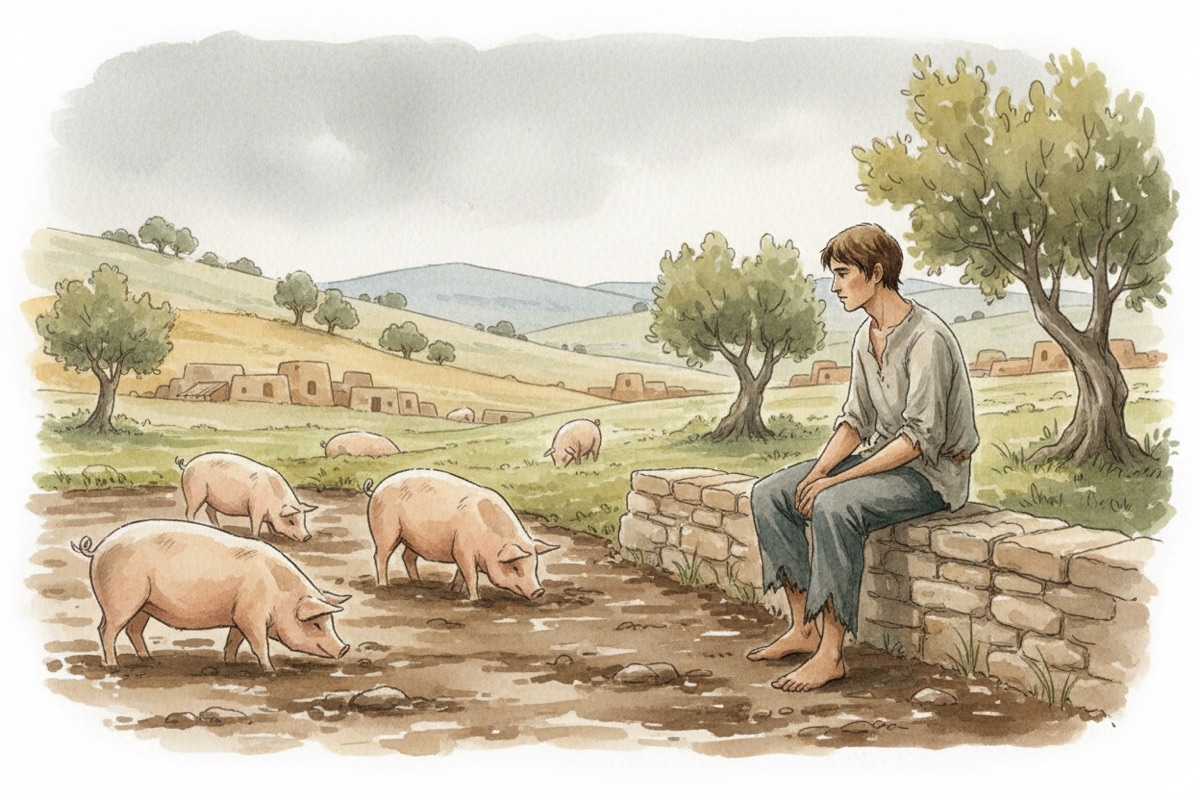
He ends up feeding pigs. The Law of Moses called the pig unclean (Leviticus 11:7). Jesus' first listeners would have felt the weight of that. This son is now as far from home as a son can get. Even then, “no one would give him a thing.”
What did the son rehearse on the way home?
He rehearsed a confession and a lower place. Hunger brings him to his senses, and he plans his words carefully: “Father, I have sinned against heaven and against you. I am no longer worthy to be called your son. Make me like one of your hired servants.” (Luke 15:18-19, BSB).
Notice what is honest about that speech. He does not blame the famine. He names his sin, and he names it first against heaven. That is honest confession.
Notice, too, what he still gets wrong. He thinks the best he can hope for is a job. He is coming home to earn his keep. Many believers walk toward God the same way. We confess, and then we offer to earn our way back into the house.
What does the running father show us about God?
The father shows that God's welcome is eager. He sees his son “while he was still in the distance.” He does not wait at the door with his arms folded. He is “filled with compassion,” and he runs.
The son begins the speech he practiced. In the BSB, it stops before the line about becoming a hired servant. Instead of a job, the father calls for a robe, a ring, sandals, and a feast: “Let us feast and celebrate. For this son of mine was dead and is alive again...” (Luke 15:23-24, BSB). The best robe was not for a hired hand.
This is the point Jesus was making to the grumblers. The Father in heaven is not reluctant. Paul puts the larger truth plainly: “But God proves His love for us in this: While we were still sinners, Christ died for us.” (Romans 5:8, BSB). God did not wait for us to clean ourselves up before He loved us.

What does Luke 15 mean for you today?
It means you can stop rehearsing your way back to God. If you have wandered, the road home is open, and the Father is not standing at the gate with a list of terms. Confession still matters. The son still says, “I have sinned.” But you say it to a Father who is already running toward you.
It also speaks to those who have never left. The story goes on in verses 25-32 to the older brother, who stayed home and refused to join the party. If you find yourself frustrated by grace given to someone else, keep reading. The father goes out to him too and pleads with him.
A prayer
Father, I have come to You before with a speech, ready to bargain for a lesser place. Thank You that You saw me while I was still far away. Thank You for the robe I did not earn. Where I have wandered, bring me to my senses and turn me toward home. Where I have stayed close but grown cold toward others who return, soften my heart. Teach me to welcome the way You welcome.
Questions for reflection
- When you confess sin to God, do you expect to be received as a son or daughter, or as a hired servant? Why?
- Who in your life is "still in the distance," and what would it look like to move toward them first?
Try Sermoneer
One sermon becomes a week of material: small group guide, devotional, social cards, and shorts.
Start free