
How-To
How to Review Your Sermon Manuscript Before Sunday
To review your sermon manuscript before Sunday, read it the way your congregation will receive it: by ear, once, in order. Check that the big idea fits in one sentence, that each section leads to the next, that nothing drags, and that sentences are short enough to follow. Then read it aloud with a timer.
Most manuscripts are written to be read. Sermons are heard. A sentence that works on the page can lose a listener halfway through, because a listener can't go back and reread it. Reviewing a manuscript is mostly the work of closing that gap.
This guide covers what to check, how to review a manuscript by hand in one sitting, and how to get a second editorial read from Sermoneer if you want one.
What should you check when reviewing a sermon manuscript?
Check what a listener needs in order to follow you. That comes down to seven things.
- The big idea. Can you say what the sermon is about in one sentence? If you can't, the congregation won't be able to either.
- The opening. Does the first minute give people a reason to keep listening, and does it point toward the text?
- The transitions. When you move from one point to the next, does the listener know you moved, and why?
- Pacing. Is there a section where you stay too long, or a heavy idea you rush past?
- Clarity. Are there long sentences, stacked clauses, or pronouns where the listener can't tell who "he" or "it" is?
- Repetition and filler. Do you lean on the same word or phrase over and over without meaning to?
- The closing. Does it land, or does it circle three times looking for a place to stop?
Typos matter less for a sermon you preach than for one you print, but they still matter. A typo in a verse reference can send you to the wrong page in the middle of the sermon.
Notice what is not on this list: whether your theology is right. That is the work of your study and of the people you are accountable to. A manuscript review is an editorial pass. Keep those two jobs separate so neither gets shortchanged.
When should you review your manuscript?
Review it after you have been away from it for a while. When you have just finished writing, you remember what you meant, so you read that instead of what you wrote. A night's sleep is often enough distance.
Timing also decides what you can fix. A review on Saturday night can catch typos and trim a paragraph. A review two days before Sunday leaves room to rebuild a transition or move an illustration. If your week allows it, aim for the earlier one.
How do you review a sermon manuscript by hand?
Do it in four passes, each with one job. Trying to catch everything in one read means you catch the small things and miss the big ones.
- Write the big idea at the top. Before you reread anything, write one sentence at the top of the first page: what you want people to know or do when they leave. Keep it in view for the rest of the review.
- Read for structure. Read only the first and last sentence of each section. Do they make a line that leads to the big idea? If a section does not serve that sentence, mark it. You may still keep it, but you should know why.
- Read for the listener. Go line by line. Circle any sentence that runs past two lines. Circle every "this," "that," and "it" where the listener might not know what you mean. Underline any word you used three or more times in a page. Mark the places where you change direction and check that you tell the listener you are changing direction.
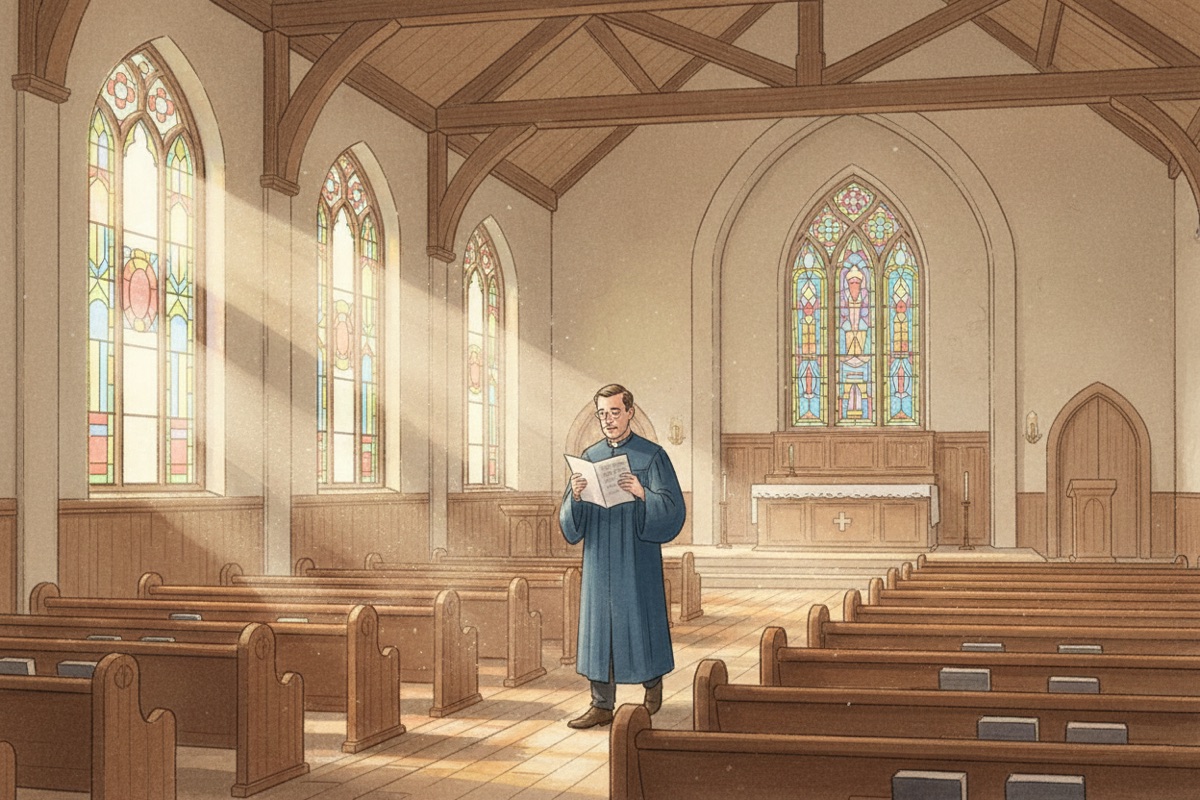
- Read it aloud with a timer. Read standing up, at the pace you preach. Mark where you stumble, because the congregation will stumble there too. Mark where your attention drifts, because theirs will drift sooner. Write the time at the end of each section so you can see where the minutes went.
After the four passes, fix things in order of size. Rebuild a weak transition before you polish a sentence. Cut a section that doesn't serve the big idea before you fix its typos.
If you have a spouse, a staff member, or an elder who will listen, read it to them and ask two questions only: "Where did you lose me?" and "What will you remember?" If what they remember is not your big idea, that is worth knowing before Sunday.
What are common problems in sermon manuscripts?
The most common problems come from writing for the eye instead of the ear.
- Sentences built for reading. A sentence with two commas and a "which" in the middle is fine on paper. Out loud, the listener drops the thread. Break it into two or three sentences.
- Missing signposts. On paper you can see a heading. In the room, people only know you moved to a new point if you say so. Short phrases like "Here's the second thing Paul does" carry more weight than they look like they should.
- The long middle. A sermon often slows down in the second half of the body, where a third illustration or an extra cross-reference sits. If you find yourself defending a paragraph by saying "but it's good," ask whether it is good for this sermon.
- The ending that won't end. When the closing restates the point several times, the strongest version gets buried. Pick the best one and stop.
- Pet words. Everyone has them. "Really," "just," and "actually" are common. Reading aloud is the fastest way to hear yours.
How do you get a manuscript review in Sermoneer?
Sermoneer's Review Manuscript tool gives you an editorial second read on your manuscript. It looks at flow, clarity, pacing, and typos. It does not evaluate theology or interpretive choices. Those stay with you.
- Add your sermon. You can paste the manuscript or upload it as a PDF, Word (.docx), or text file. You can also add a YouTube link if the video has captions, but for a review before Sunday you need the manuscript, since the sermon hasn't been preached yet.
- Open the sermon when it is ready and choose Review Manuscript under Tools.
- At the top, you get a listenability score out of 10 with a short note each on structure, clarity, and pacing.
- Below that, What's working lists a few things in your manuscript worth keeping.
- The Issues list follows your manuscript from start to end. Each issue is labeled (typo, grammar, flow, clarity, transition, pacing, or repetition), quotes a short line from your manuscript, explains the problem, and offers a specific fix after Try:. Because the quoted line comes from your manuscript, you can usually use your word processor's find command to jump to it.
- Start here names one revision to make first if you only have a few minutes.
- Make the changes in your own document. The review does not edit your file. If you want a fresh read, press Re-run review. The review isn't saved. If you leave the sermon and come back later, it runs a new review, so copy any notes you want to keep.
Treat every note as a suggestion from a peer reader. Some suggested rewrites will sound like you and some won't. Keep the ones that help a listener follow you, and ignore the rest. A suggestion that smooths a sentence but takes the edge off something you meant to say sharply is one to ignore.
Use the score to compare one draft with the next. If a draft scores lower than you expected, read the structure and pacing notes before the issues list. They usually explain why.
What should you do after the review?
Read it aloud one more time. Every change you make on paper changes the sound, and a fix in one paragraph can break the flow into the next. A final read at preaching pace is the only way to hear that.
Then stop editing. A manuscript can always get better, and at some point the better use of your Saturday is prayer and rest, not one more pass. Once the manuscript is settled, the main points are ready for the other things Sunday needs, like the handout. See how to write sermon notes for the bulletin.
How long should a sermon manuscript review take?
Plan for at least as long as you preach for the read-aloud pass, plus time for the other three passes and the fixes. If you consistently run out of time, review a section at a time across the week instead of the whole manuscript at once.
If you want an editorial second read alongside your own, you can try Sermoneer free during the beta with this week's manuscript.
Try Sermoneer
One sermon becomes a week of material: small group guide, devotional, social cards, and shorts.
Start free