
Pastor's Life
How to Preach When You're Running on Empty
When you're running on empty, preach a smaller sermon that stays close to the text. Read the passage slowly, explain what it says, and give one clear application. Do not chase a big new idea or try to perform energy you do not have. Then, after Sunday, deal with why the tank is empty.
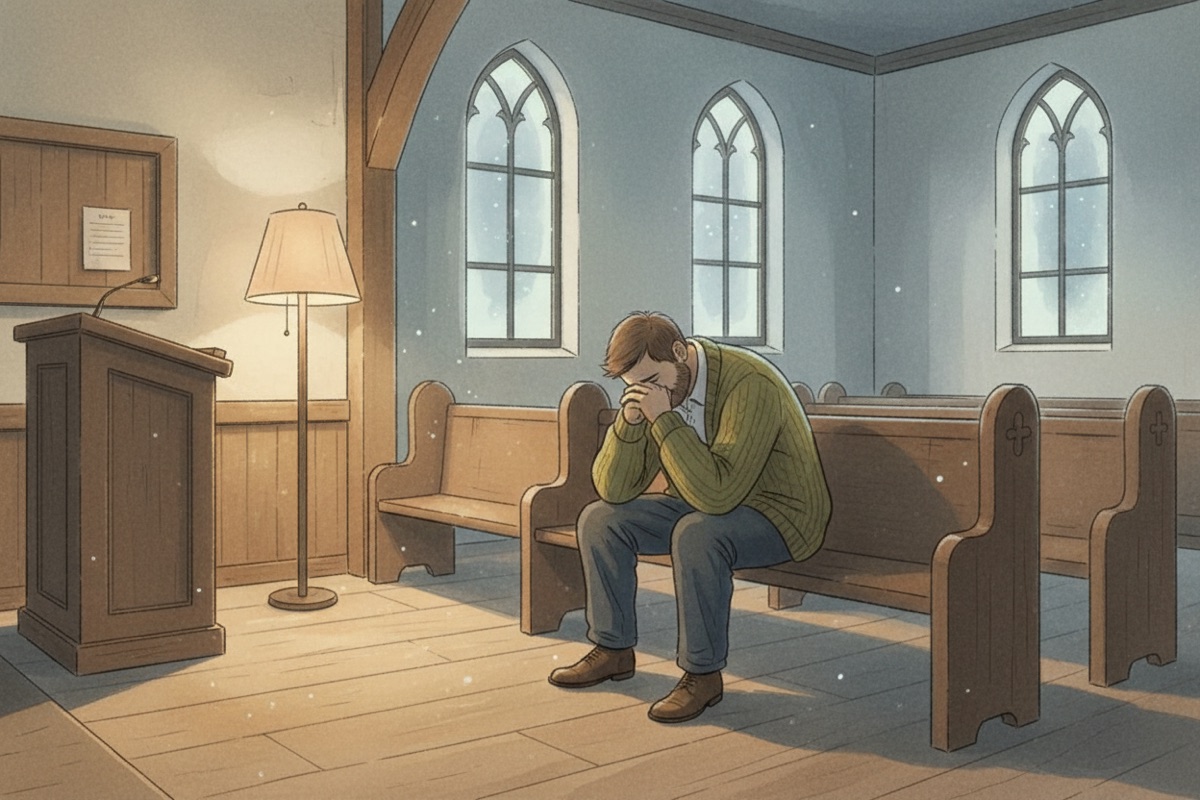
Say it is Thursday night. A funeral took Tuesday. A hard phone call took most of Wednesday. You have a passage, a few notes, and nothing in you that feels like a sermon. Sunday is still coming.
You may know this week well. The question is what to do with it.
What should you do when you have nothing left to preach?
When you have nothing left to preach, make the sermon smaller and let the text carry more of the weight.
That sounds simple, but it runs against instinct. An empty week makes us want to compensate. We worry the sermon will feel thin, so we reach for more: another illustration, a clever angle we found online at midnight. We try to make up for low energy with volume.
That usually makes things worse. The extra material takes time you do not have. It pulls the sermon away from the passage. And on Sunday you end up working harder in the pulpit to hold together something you did not have the strength to build.
A smaller sermon asks less of you and gives more of the text to your people.
What does a smaller sermon look like?
A smaller sermon has one point from the passage, a careful reading of the text, and one application. It is usually shorter than your normal sermon, and that is fine.
Here is one way to build it with what you have left:
- Read the passage out loud several times. Do this before you open a commentary or your notes. Mark what stands out. On a tired week, the plain sense of the text is your most reliable guide.
- Write the one thing the passage says. Finish the sentence "This passage shows that..." in words a twelve-year-old would follow. If you have three points in your notes, ask which one the text itself makes most clearly. Keep that one.
- Let the passage be your outline. Walk through it in order. Explain each part, then show how it supports the one thing you wrote down. You do not need a creative structure this week.
- Choose one illustration, or none. If a story comes easily and fits, use it. If not, leave it out. A clear explanation of the text is better than a strained story.
- Give one application. Name one thing your people could do or believe differently this week because of this passage. One is enough.
- Stop when you are done. If the sermon runs ten minutes shorter than usual, let it. Do not fill the space with repetition.
You can preach this from a page of notes, prepared in the hours you actually have. It also keeps you anchored to Scripture on the week you are least able to anchor yourself.
Does God use a sermon preached on empty?
God has used weak preachers before, and Scripture says so plainly.
Paul did not arrive in Corinth full of confidence. He wrote, “I came to you in weakness and fear, and with much trembling” (1 Corinthians 2:3, BSB). He went on: “My message and my preaching were not with persuasive words of wisdom, but with a demonstration of the Spirit’s power, so that your faith would not rest on men’s wisdom, but on God’s power” (1 Corinthians 2:4-5, BSB).
Paul's weakness there was not the same as your tired week. He had chosen not to lean on eloquence. But the principle reaches you too. Later he described the whole ministry this way: “Now we have this treasure in jars of clay to show that this surpassingly great power is from God and not from us” (2 Corinthians 4:7, BSB).
Paul still prepared and still labored. He could say, “I worked harder than all of them” (1 Corinthians 15:10, BSB), and in the same breath add, “not I, but the grace of God that was with me” (1 Corinthians 15:10, BSB). Hard work and dependence on grace sat together in him.
So you are still responsible to handle the text faithfully. What you can set down is the quieter belief that the power of Sunday depends on how full you feel on Saturday. You are not the one who supplies the power.
That frees you to preach the passage plainly. God says of his word, “it will accomplish what I please, and it will prosper where I send it” (Isaiah 55:11, BSB). A plain sermon that reads and explains the text puts that word in front of your people.

Should you tell anyone you're running on empty?
Yes, tell someone before Sunday, even if you never mention it from the pulpit.
It is easy to carry an empty week alone, afraid that saying it out loud would make you look unfit for the job. But the people closest to you may already sense something is off. Telling them lets them help.
If it is safe to, call an elder or a trusted member of your board. Tell your spouse, or a friend in ministry. You do not need a plan. "I'm running low this week" is enough. Then let them take something off your plate. Someone else can lead the prayer time or handle the Saturday call you were dreading.
Whether to say anything to the whole congregation is your call. Some pastors find a short, honest sentence helps. Others find it pulls attention away from the text. Either way, the pulpit should not be the first place anyone hears it.
What if every week feels empty?
If every week feels empty, a smaller sermon will not fix it.
A hard week after a funeral passes. Months of dread, poor sleep, and a numbness that does not lift after a day off point to something deeper. Your load or your health needs attention.
Two honest questions can help you see it:
- When did you last take a full day off, with your phone away?
- Has anyone told you that you seem different lately?
If the answers worry you, take them to your elders or board, and talk about your schedule as a shared problem. Logging a normal week can give that conversation something concrete to look at. And if the low mood does not lift, see a doctor or a licensed counselor. None of that is a failure of faith. It is part of caring for the one body you have been given to serve with.
If you are having thoughts of ending your life, call or text 988 (the Suicide & Crisis Lifeline in the US) today, or go to the nearest emergency room.

What should you do before the next empty week?
Before the next empty week comes, decide now that you will preach small when it does.
Write the six steps above on a card and keep it in your Bible. When Thursday night comes and there is nothing in the tank, you will not have to decide what to do. Open the text and read it out loud. Start there.
Try Sermoneer
One sermon becomes a week of material: small group guide, devotional, social cards, and shorts.
Start free